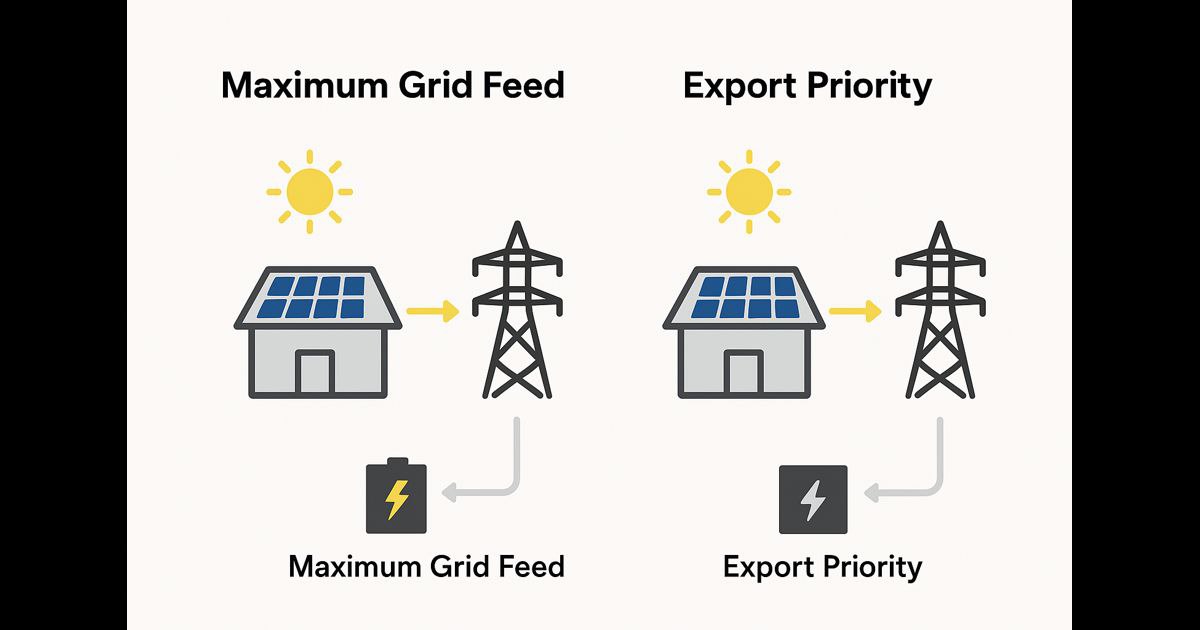
Maximum grid feed: This setting allows your system to send all available surplus electricity (that you don’t use yourself or store in your battery) to the public grid. In other words, nothing is held back — whatever isn’t consumed on-site will be exported.
• Export priority: When this is enabled, your system will prioritize selling power to the grid over charging the battery. For example, if your panels are producing more than you’re using, the system will first export to the grid (to benefit from injection tariffs) and only charge the battery afterwards.
The difference between Maximum Grid Feed and Export Priority :
• Maximum Grid Feed → This is a limit setting.
It defines how much electricity your system is allowed to send to the grid. If set to the maximum, there’s no cap – all excess solar production can go out to the grid. If set lower, export would be restricted (e.g. limited to 70% of inverter power).
• Export Priority → This is a decision rule.
It tells the system what to do first when there’s extra solar:
• With Export Priority ON: the system sends surplus power to the grid first, before charging the battery.
• With Battery Priority ON: the system charges the battery first, and only exports to the grid once the battery is full
Was this article helpful?
That’s Great!
Thank you for your feedback
Sorry! We couldn't be helpful
Thank you for your feedback
Feedback sent
We appreciate your effort and will try to fix the article